


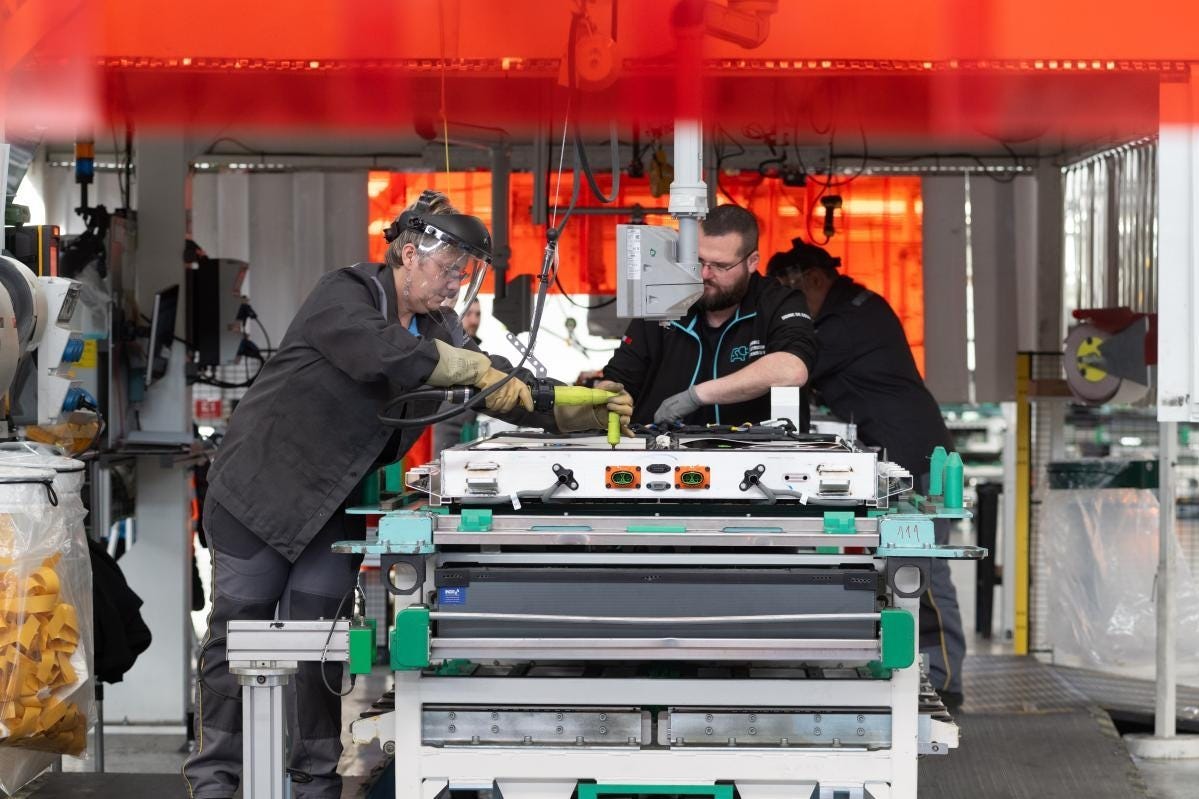
Large-scale battery cell production. Credit: © Volkswagen AG
Last month 49% of Volkswagen’s flagship Spanish battery cell plant was sold to the Chinese company Gotion High Tech, and its planned output was scaled back in the same deal. Days later, the Renault-backed French battery maker Verkor confirmed it was reopening negotiations with creditors following delays to its plans.
These two recent developments tell the same story.
Despite fifteen years of European policies that were supposed both to create demand for batteries and to drive positive economic benefits (through industrial policies, market regulation and innovation support), Europe’s battery industrial ecosystem remains, in the diplomatic words of Carnegie’s latest analysis, “structurally fragile.”
Batteries: the crucible of Europe’s growing dependence challenge
Batteries are just one area where the continent’s industrial and economic dependency, or indeed vulnerability, has flipped from forecast to fact.
This technology is increasingly critical for European states, not only because it is integral to their efforts to reduce the environmental footprint of their economies, but also because it underpins both defence needs and industrial renewal: from energy systems and the grid to military drones and industrial capabilities such as the auto sector. (Its why a country like France has designated the technology as a priority industry alongside things like semiconductors and advanced nuclear.)
The EU installed 27.1 GWh of new battery storage in 2025, a twelfth consecutive record year, with projections for the market running to 600 GWh of installed capacity by 2030. Most of the demand remains in the auto sector, but a growing part of it is coming for grid-scale storage projects that can help balance power grids and reduce expensive and insecure gas imports.
Yet most of the lithium-ion batteries Europe imports come from just one country: China. Our Dependence report puts China’s share of Europe’s lithium-ion battery imports at 88 per cent, up from 75 per cent in 2019.
Notes from the ground
I have spent much of this year in the rooms where European policymakers and industry leaders are grappling with ways to capture more of the economic benefits of this growing market.
In June I stood on the floor of Europe’s largest battery gigafactory in Poland. The plant, run by the Korean firm LG Energy Solution fifteen kilometres outside Wrocław did not exist a decade ago. It now makes more lithium-ion battery cells than any other place in Europe, contributing 3% of Poland’s GDP and employing 4,500 Polish and 1,500 Ukrainian workers.
This factory shows what successful battery manufacturing in Europe could look like. But in the face of cheaper Chinese alternatives, it is reportedly running at about half capacity, and it has not been widely replicated. More than 700 GWh of announced European cell capacity has been rolled back or cancelled in the last year alone.
The failures have come one after another: Northvolt, Morrow, Varta.
Meanwhile, more than half the electric vehicles built in Europe in 2024 ran on batteries made in China or elsewhere in Asia. Two billion euros of European public money has subsidised these Asian battery manufacturers over the past four years.
Carnegie’s trade data puts Chinese battery exports at more than six billion dollars a month, nearly half of them bound for Europe.

At this year’s Battery Show in Stuttgart, I asked a major supplier how much of an electric car’s value sits in its battery. They put it at 40%, and at around half for a grid-scale storage system. Others have put the figure even higher. Importing batteries therefore sends a substantial share of the value of those products abroad, and creates a serious supply vulnerability for some of Europe’s most strategically important and valuable industries.
Public opinion suggests people understand these dangers: voters want more of their energy technology built at home. Polling by Loom found broad cross-spectrum support for domestic clean-energy production across Germany, France, Spain, Poland and Hungary. The research found that where the clean energy technology is made matters more to respondents than the jobs it creates. Seventy per cent of respondents backed building more at home even if deployment slows and costs rise. Support extended across political, income and age groups.
But this public preference is far from being realised.
Europe’s (in)capability
Over the past few months Loom brought together more than fifty practitioners from battery companies, investors and buyers in the automotive and defence sectors for discussions close to Europe’s battery industry hubs in Sweden, Spain and Germany. We asked them what’s been going so badly wrong and how to fix it.
Those rooms filled with cell makers, financiers and buyers, but almost nobody from the layer that participants consistently named as the weakest point in the chain: the cathode and anode materials, and the precursor chemicals they are made from. Only two of the participants worked on making these materials, which reflects a major gap in Europe’s industrial capabilities.
As geopolitical conditions shift, this gap has clear implications for the continent’s energy and economic security. Attempts to close it have foundered, and their failure has cast a long shadow over the many European initiatives that were supposed to support re-industrialisation.
The shadow of Northvolt
The Swedish battery maker Northvolt had serious capital behind it: Volkswagen, Goldman Sachs, the European Investment Bank, and a €2bn supply contract with BMW.
Much of what went wrong was in the company’s own making. It never got its yields up. It expanded into Germany, Canada and Poland before its first plant was even working, and it lost the BMW contract in 2024 for late delivery. It filed for bankruptcy with $5.8bn of debt.
But underneath its own mistakes sat an exposure that was not Northvolt’s alone. It was building a graphite-anode cell at a moment when graphite had become a geopolitical lever: from 2020 Chinese regulators stopped issuing export licences to Sweden. Shipments all but vanished through 2021 and 2022, precisely when Northvolt was trying to scale.
This exposure is not exceptional. Loom’s Dependence report found that a company reshoring cell manufacturing within Europe, or relying on supply from even a trusted ally such as South Korea, will likely still import its cathodes and anodes from China. In other words, it may benefit from jobs at the final assembly stage (as at the new VW-Gotion and Stellantis-CATL factories in Spain), but it leaves important exposures higher up the supply chain untouched.
Materials and manufacturing knowledge
One industry estimate puts the number of people in Europe with integrated process knowledge of the battery value chain, from lab scale to industrial production, at just 200–300.
Cell production in Europe also depends on imports of the main materials that go inside batteries: precursor, cathode and anode materials. Umicore’s plant at Kokkola in Finland is the only operating precursor facility on the continent, and Europe has no industrial-scale LFP (lithium iron phosphate) cathode production. The first plant is being built at Bitterfeld, Germany, and VW’s PowerCo has bought its entire output for ten years. Europe’s synthetic graphite anode production amounts to just two thousand tonnes a year, from one plant in Norway: enough for just thirty thousand cars.
According to the battery industry association Recharge, the ‘Made in Europe’ proposals being debated in Brussels do not act to reduce these supply vulnerabilities.
Europe’s defence sector is now exposed to this same chokepoint.
Foundational industries such as the auto sector were repurposed for military production in the Second World War and are being called on again to serve defence needs. Their equipment, workforce and know-how are weaker than they were, and what remains often runs on Chinese inputs that could be cut off.
Loom’s Dependence report rated the risk of Europe’s defence sector becoming hyper-dependent on China for key components like batteries as very likely, with a high impact on national security. On that assessment, defence could be the buyer with most to lose if Europe’s sovereign supply of batteries fails. So could defence orders also help put Europe’s battery industry onto a firmer footing?
At our event in Valencia in March, a defence supplier said its customers would pay a premium of up to 80% for battery supply from a trusted European supplier. Defence and government participants in a separate meeting I attended offered a similar estimate. Drone company executives also told colleagues at this year’s Munich Security Conference that they too would pay more to meet what they described as ‘NATO requirements’ for sensitive inputs to be produced within the alliance. These conversations suggest that some defence buyers are willing to pay a premium for secure supply, which could therefore anchor more of a domestic industrial base.
But defence accounts for just 1–2% of total battery demand, and that demand is split across 34 allied sub-markets. RUSI puts the scale plainly: a single production line in an EV battery plant can put out 8 GWh a year, dwarfing total military demand. (For context: the US military’s demand is only expected to reach 1GWh.)
As well as being relatively small, defence demand is slow: it moves on procurement cycles of six to eight years. The room we convened in Stockholm treated that as disqualifying, and for good reason: a plant needs committed off take before it is built, not six years afterwards.
There is another way to read this. The slowness that disqualifies defence as a market is what could qualify it as a first customer. A buyer on a six-to-eight-year cycle is a buyer who can sit through a slow ramp-up: the years of poor yield and uncertain delivery that no carmaker will accept. Defence cannot supply the volume an industry needs. But it could supply patience.
Defence money also has freedoms industrial money does not. The EU aims to mobilise up to €800bn in defence investment, and its €150bn SAFE loan instrument requires at least 65% of component costs to come from the EU, EEA or Ukraine: an origin condition the EU is still arguing over on the civil side. Defence budgets can also favour European suppliers, because defence procurement benefits from security exemptions under EU state aid and procurement rules and at the WTO. But these flexibilities are not currently being used to build a more sovereign battery supply chain.
One likely obstacle is that procurement is siloed. Defence and wider energy industrial budgets are appropriated separately by different decision makers, and judged against different objectives, so no single lever can be pulled to strengthen security of supply. The companies that sit between these fragmented markets often fall through the gap as a result, something highlighted in our recent Loom100 research.
Partnerships and control
Where Europe does have a nascent cell-making industry, it still depends heavily on foreign partners for the investment, the tech and even the workers.
Stellantis’s Spanish battery factory, for example, is a joint venture with China’s CATL. As things stand, the know-how and intellectual property stay on the Chinese side of this deal. In Valencia, we heard that Spain had put close to €300m of public money into this project, but the workforce would still largely not be local, and the technology would likely not be transferred into European hands. The picture looks similar at Debrecen in Hungary, where a large CATL plant is due to open to supply BMW.
Most of the value creation, Bruegel argues, will remain in the upstream segments of the supply chain that China controls, not in the final assembly stages that will happen in Europe.
In other words, it is now the terms associated with these deals where it is decided whether European companies will gain access to leading production technology, or only to the cells and to older technology. They also determine what benefits, if any, these projects unlock for local people in the countries hosting these factories.
For future investments, the EU’s draft 'Industrial Accelerator Act would require foreign investors to license their technology, and to hold only a minority stake in these projects. But the deals already announced fall outside its scope, and technology transfer need Chinese approval in any case.
Since 1 July, China’s outbound investment rules route transferred technology through a national security review, right down to the training and secondments through which know-how actually moves. Earlier this month China announced it will restrict exports of many types of battery technology, as it has done with rare earths.
Europe can still set conditions to secure more control and more local benefit. But member states are divided over how far to go, and reports suggest the proposals are being weakened ahead of a decision from leaders, which is supposed to come before the end of this year.
Diversifying supply
By contrast, Japan is taking steps to reduce its dependence on a single supplier country for batteries. For example, the country’s long-term auction pays fixed costs for twenty years to secure battery supplies, and it caps any single supplier country at 30% of awarded storage capacity.
South Korea is also taking a different approach: it is selling battery cells, nuclear baseload and NATO-grade defence exports as one joined-up offer. Poland, which hosts Europe’s largest cell plant thanks to Korean investment, has bought more arms from South Korea than from the United States since 2021. In April it made Seoul a comprehensive strategic partner with defence described as the “driving force” of the relationship.
Meanwhile, the rest of Europe seems to be keeping these two discussions – over defence and energy procurement - separate.
Loom’s polling found 75% of respondents naming US tariffs and export controls among their sharpest concerns about energy insecurity, and batteries are one of the areas where these could bite hardest.
Restrictions on battery trade are already in place in the USA: Washington recently sanctioned eight Chinese battery manufacturers, and an executive order signed in August by President Trump lets the US Energy Department bar Chinese grid equipment from American networks, battery storage systems included, and ordered installed equipment to be removed. Over time, we could expect US pressure on Europe to follow suit.
It is interesting that an American company, Lyten, is betting on Europe as a market in which to compete on batteries, despite the Chinese competition, albeit their focus seems to be powering data centers, robotics, and drones.
Lyten bought Northvolt’s completed Swedish campus and Europe’s largest battery R&D centre out of bankruptcy, and may also obtain Morrow (another European firm that was forced into bankruptcy despite the backing of Norway’s wealth fund.) Lyten says its lithium-sulphur chemistry needs no graphite anode and no critical-raw-material cathode.
Lyten site in Heide, Germany, 1 July 2026. Credit: © Lyten
What will happen now?
Europe has a large market it could still leverage access to strategically, and it retains innovation, R&D and human talent strengths across a range of new battery chemistries, including ones that hold the promise to reduce exposure to such high levels of critical mineral demand.
European nations could still choose to link access to their market to greater local benefits like jobs and skills investment, more diversity of supply over materials, and more sovereign control over ownership and technology IP. It could also deepen its partnerships with allies like Korea and Japan that offer the potential to grow supply chain resilience through joint ventures and other forms of collaboration.
But last week France and Germany, under pressure from their auto firms who want to protect the supply of cheap Chinese batteries for their cars and to keep costs down, agreed a joint position that just 10% of a battery’s content need be “European”. Cells technically ‘made in Europe’ (according to these new criteria) already met 48% of European EV battery demand in the first four months of this year. On that basis, the proposed threshold is roughly a fifth of the share Europe already supplies.
That reported Franco-German deal seems to expressly permit Europe’s car firms to essentially become almost wholly reliant on Chinese batteries. If adopted, it would seem to remove one of the few remaining policies that could have supported a European controlled battery industry and begun to address this critical strategic chokepoint.
European Parliamentarians are expected to vote on this in November. We’ll then learn where the continent stands on the painful trade offs: take steps to shore-up security and prosperity for the long-term, or muddle through under the pressure of short-term commercial realities.
