


Global demand for critical minerals is rising rapidly as they become indispensable across the energy transition, digitalisation, AI, and the defence sector. The International Energy Agency (IEA) estimates that by 2040 demand for rare earths is expected to double, graphite to rise fourfold and lithium eightfold. The race to secure these minerals is already reshaping alliances and supply chains. Less visible is who is capturing them on the ground, and how much is moving through criminal hands before the state sees the benefit.
To raise the stakes, a fierce geopolitical competition is underway to secure these critical minerals, diversify supply chains, and reduce dependency on China—which holds a quasi-monopoly over these minerals, particularly in the midstream processing sector, creating numerous bottlenecks and strategic vulnerabilities for Europe.
This tense geopolitical landscape has prompted countries like the US as well as many middle powers to actively seek ways to diversify and secure their supply chains. Consequently, their attention is turning toward nations with immense production potential, including Brazil and Latin America as a whole.
For producer countries, this carries a real opportunity. Securing supply, and developing these resources can run together, and Latin American nations can position themselves as strategic partners to Europe, scaling up their own midstream capabilities and market share rather than exporting raw ore alone.
Countries like Chile and Argentina are already leading suppliers of the lithium and copper needed to manufacture electric vehicles and renewable energy infrastructure. Brazil is following. As part of its Energy Transition Roadmap, Brazil has launched a dedicated policy surrounding critical minerals, with a particular focus on graphite and rare earth elements. There are already exploration licenses and advanced projects in the pipeline, backed by a small but growing number of active commercial operations across the country. The world is watching its options, especially post-US intervention in Venezuela, where the government there also just unveiled a new mining policy, opening its doors to international consortiums and private investors.
Organised crime and the cautionary tale
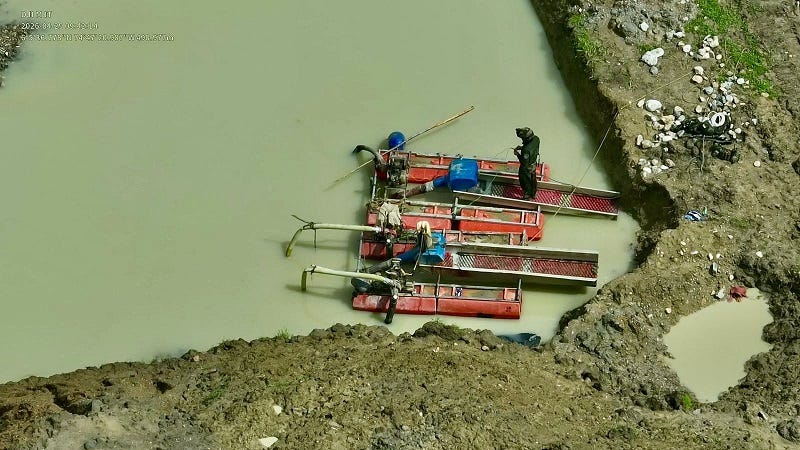
However, there is a looming threat that few are talking about. In areas lacking formal governance—where organised crime controls vast territories and the state fails to project the rule of law—criminal groups are already moving into critical minerals. We’re working with the criminologists and investigators at Amazon Underworld who have already reported how critical minerals are illegally exploited in Venezuela and laundered into international supply chains. Minerals are smuggled across the Colombia–Venezuela border, and significant volumes are seized in transit across the region. We’ll publish more information about this in the coming months, but it’s already clear that without a regulatory framework, technical know-how and access to technology for tracking crime and enforcing the law, the state fails to control either extraction or sale. Gold is the cautionary tale.
What gold shows
Across wide areas of the Amazon, transnational organised crime networks dominate gold extraction. This gold is laundered in small towns before entering global supply chains and reaching international markets. Today, it is estimated that illegal profits from gold actually surpass those of the entire cocaine market. For example, roughly 40 percent of gold exported from Peru is of illicit origin; that figure spikes to around 80 percent in Colombia.
The consequences are devastating. Illegal mining drives deforestation, water pollution, and severe human rights abuses against local communities, and it strengthens the criminal groups that control the territory. Our new research work, produced in partnership with Colombian think tank Fedesarrollo and launched last week following discussions with industry, policy makers, mineral and crime experts, has been capturing headlines in the country over the last few days. It set out the huge revenue potential ($2.4 - 4.6 billion) for the State - of around 7 years of the investment in the Ministry of Defence or 13 of the Ministry of Environment- if actions are taken in the next 5 years. Ultimately, every dollar captured by criminal groups is a dollar stripped from local development, while raising the state’s cost of combating crime.
But the window to prevent organised crime’s dominance over critical minerals is still open.
Trade-offs and consensus
That window will not stay open long, and acting within it is not cost-free. Critical minerals are indispensable; the energy transition and the reduction of our reliance on fossil fuels depend entirely on them. But mining draws fierce resistance in parts of the population, including fear of environmental destruction and of an enclave economy that extracts wealth while leaving little behind, sharper still where indigenous communities are involved and where deposits sit in protected areas like the Amazon. An honest approach has to hold both at once: the cost of acting, and the cost of leaving the field to the networks already moving into it.
For producer countries, including new governments like the incoming administration in Bogotá, and for international partners, the opportunity is to keep organised crime out of these supply chains. The goal is to build an alternative for critical value chains—one that reduces hyper-dependency and lasts because it addresses the realities on the ground.
This requires clear rules of the game, broadening the coalition to include local authorities and communities, and equipping key actors with the technical and technological tools they need. Direct engagement and practical solutions matter even more now, especially as existing multilateral forums face significant limitations in achieving consensus and delivering real-life results. That’s why, in the months ahead, Loom is working with local partners in the Amazon to listen to the people living in communities near to the mines.
Success will require broad, cross-spectrum buy-in, strong support from local communities, and regulation that genuinely limits environmental harm—which is usually far worse at criminal mining operations than among responsible miners acting lawfully.
Whoever sets the terms for these minerals now will decide who profits from them for a generation.
