


For more than a decade, European leaders have sold the clean energy transition as an engine of jobs and growth. The economic case is still widely seen as strong. Project Tempo’s 2026 EuroPulse research found that 64 per cent of Europeans consider renewable energy important or essential for economic growth.
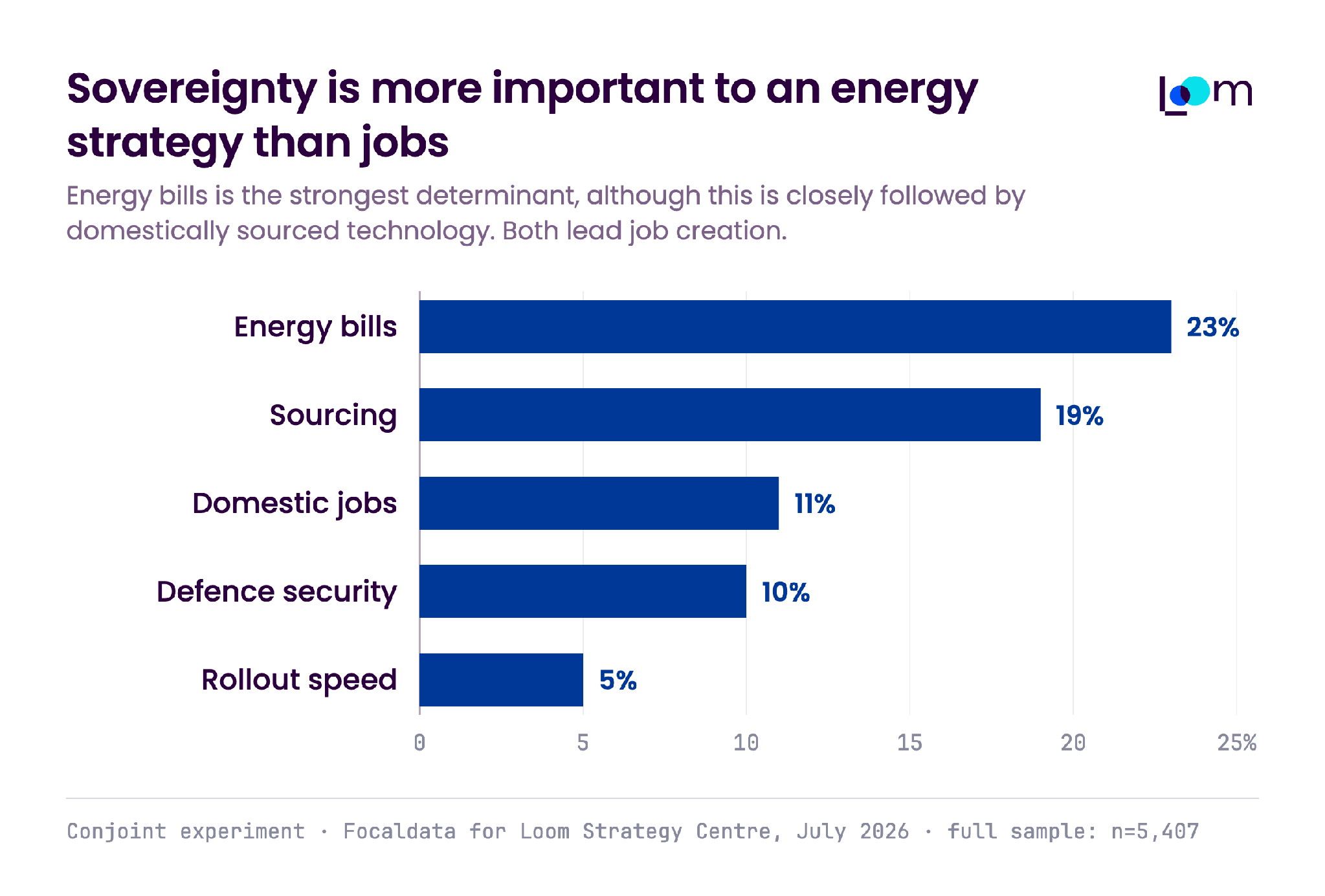
But new polling by Focaldata for Loom reflects people now put more of a priority on energy sovereignty. Where clean-energy technology was made influenced respondents’ choices more than the domestic jobs it created. Only household bills mattered more, but in France and Poland, technology sourcing mattered even more than lower bills.
Focaldata asked more than 5,400 people across Germany, France, Spain, Poland and Hungary to choose between competing national energy strategies. Household bills generally had the biggest effect on which strategy people chose, scoring 23 per cent. Sourcing followed at 19 per cent and domestic jobs at 11 per cent.
The sovereignty premium
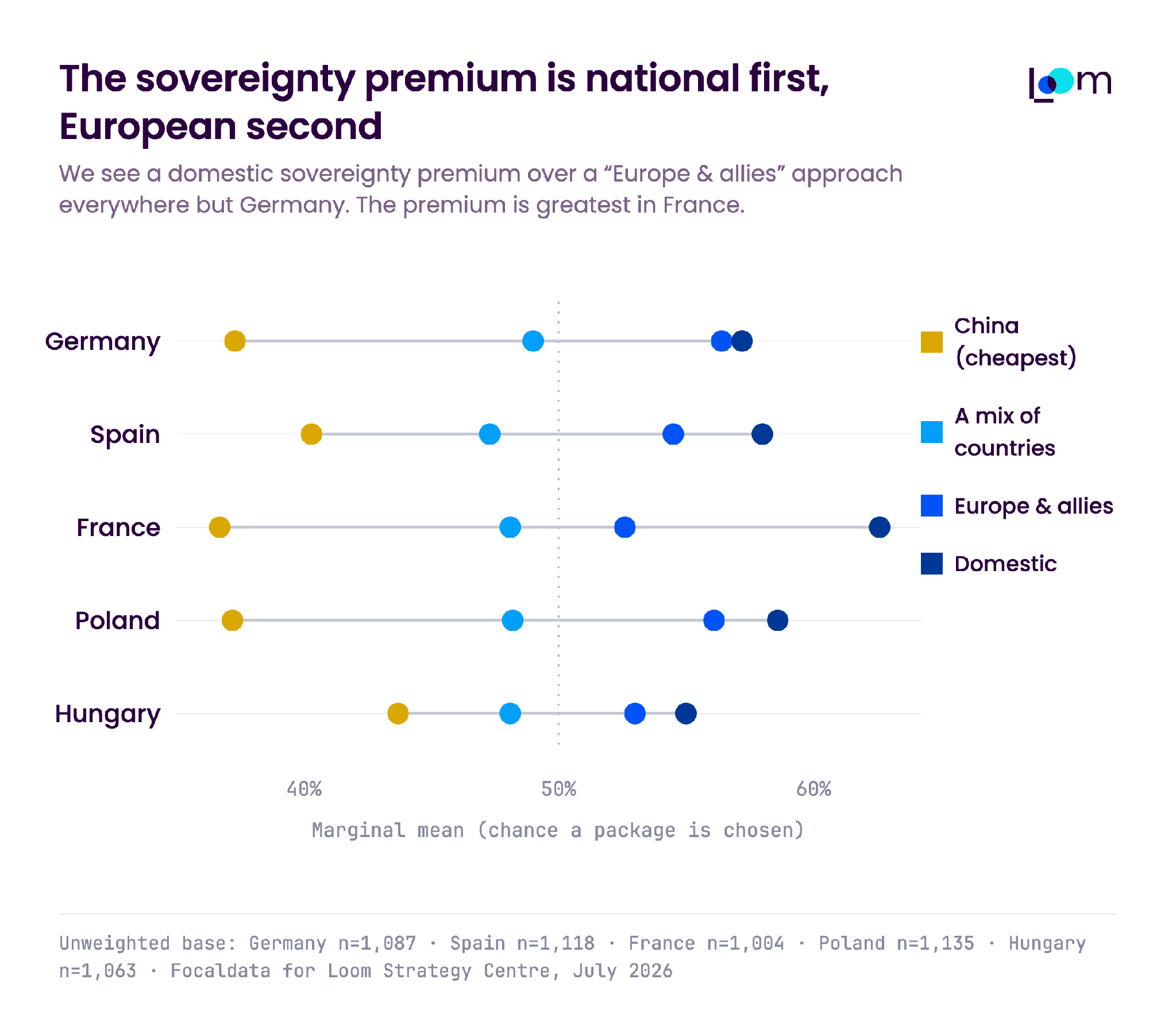
But low prices did not settle the sourcing choice. In fact, in the choice experiment, “made mainly in China” was clearly presented as the cheapest sourcing option and yet it was rejected most heavily in all five countries.
“Made mainly domestically” was the most preferred sourcing choice. Technology made in Europe and allied democracies was a close second. The narrow gap suggests that governments could combine domestic production with allied supply; Germany placed the two options level.
The poll follows Loom’s Dependence report, which traced Europe’s reliance on China for the technologies underpinning the energy transition. It highlighted 2024 data showing China supplied 98% of Europe’s solar panels. China’s share of Europe’s lithium-ion battery imports stood at 88%. Six in ten inverters - the devices that make solar and wind power usable - also came from China.
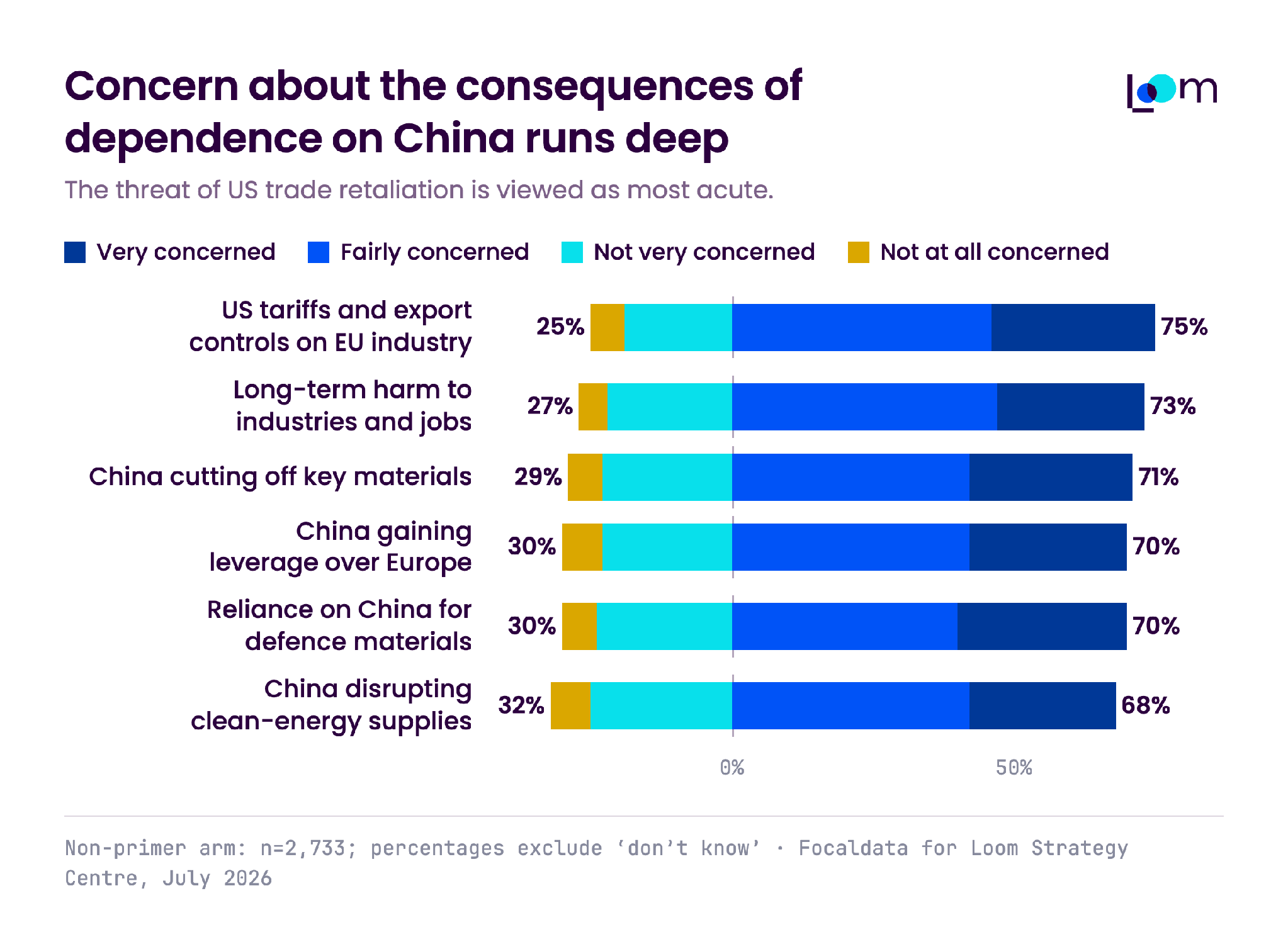
Of the dependence risks we identified in that research, US tariffs and export controls drew the highest concern in our poll, at 75 per cent, and long-term harm to industries and jobs followed at 73 per cent. Yet concern about jobs had no significant association with support for domestic production. Support was stronger among respondents concerned about the risks from US tariffs, China’s leverage over Europe, and reliance on China for defence materials. These findings suggest that securing more control over energy, more than employment, is driving the preference for domestic production.
Perhaps it should come as no surprise after years of trade and energy supply shocks.
Broad, cross-spectrum consensus
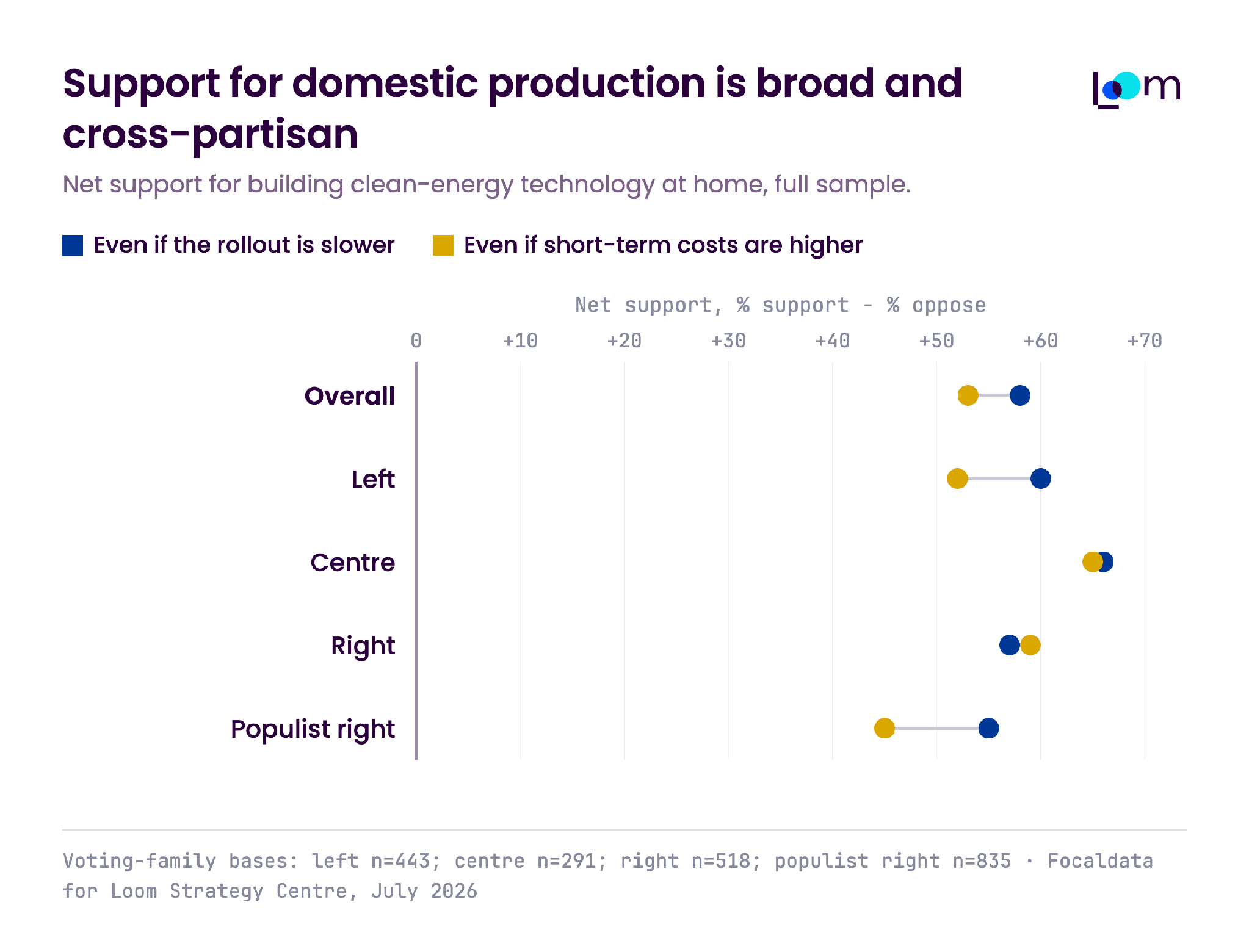
Voters are prepared to pay something to get more control. Across the five countries, 70 per cent supported building more clean-energy technology at home even if deployment slowed, and 67 per cent supported it when domestic production meant higher energy costs in the short term. (Only 9 per cent opposed the slower option and only 11 per cent the costlier one.) But public opinion also favours continuing to advance clean energy efforts over abandoning them due to the risks.
The breadth of that support for a switch to clean energy - but for one made at home - is striking. When so much political debate on energy and other issues have become so polarised the cross-spectrum consensus for greater energy sovereignty holds across age and financial position.
Net support also remained positive in every voting family, including the populist right, and even when domestic production meant higher short-term costs.
The household energy bill
The choice experiment we ran shows where this broad coalition becomes vulnerable. Respondents rejected strategies that pushed household bills up sharply. The poll establishes a willingness to accept some delay and some short-term cost; it does not establish how large a premium households would be prepared to bear.
Who pays the sovereignty premium is now the question, and can policy be designed so investment delivers a wider boost to national economies? Public budgets are constrained, while making companies pay through lower margins could make projects harder to finance. But the poll shows the limit of doing it via energy bills. There is no easy choice.
Explore the findings in greater depth here.
The industrial choice
These survey results come at a critical moment, just as European leaders debate “China shock 2.0” and prepare for the final negotiations on proposed “Made in Europe” policies in the weeks ahead.
It’s a crucial fork in the road because much of Europe’s clean energy production capacity remains ‘planned’ rather than ‘operating.’
What happens to this pipeline may hinge on the political choices over industrial policy that get made in the next few months.
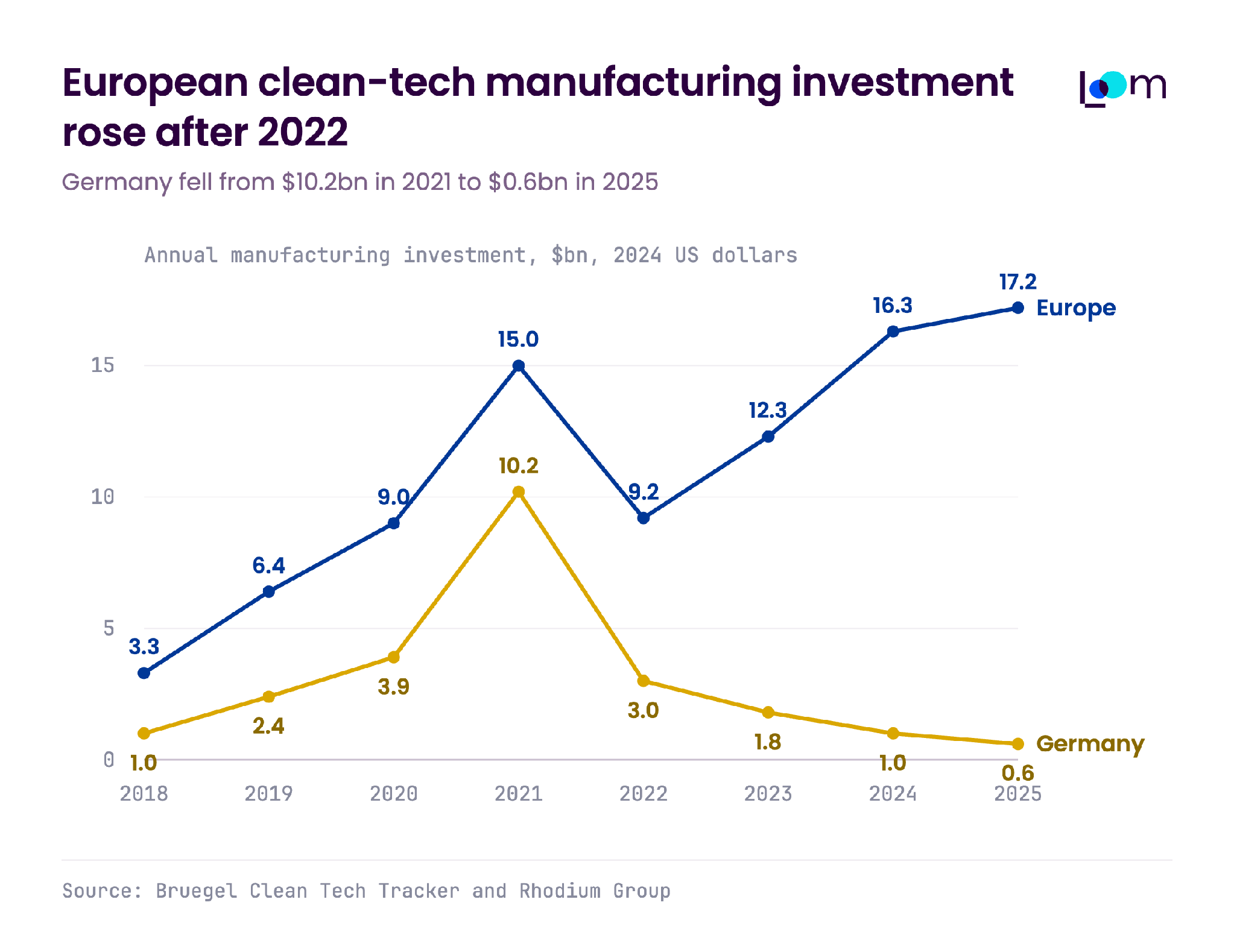
Manufacturing figures from the Bruegel Clean Tech Tracker and Rhodium Group’s Clean Investment Monitor, supplied to Loom in August, shows annual clean-tech manufacturing investment across Europe rose from $9.2bn in 2022 to $17.2bn in 2025, measured in 2024 US dollars. Germany peaked earlier and moved the other way, falling for four consecutive years from $10.2bn in 2021 to $0.6bn in 2025.
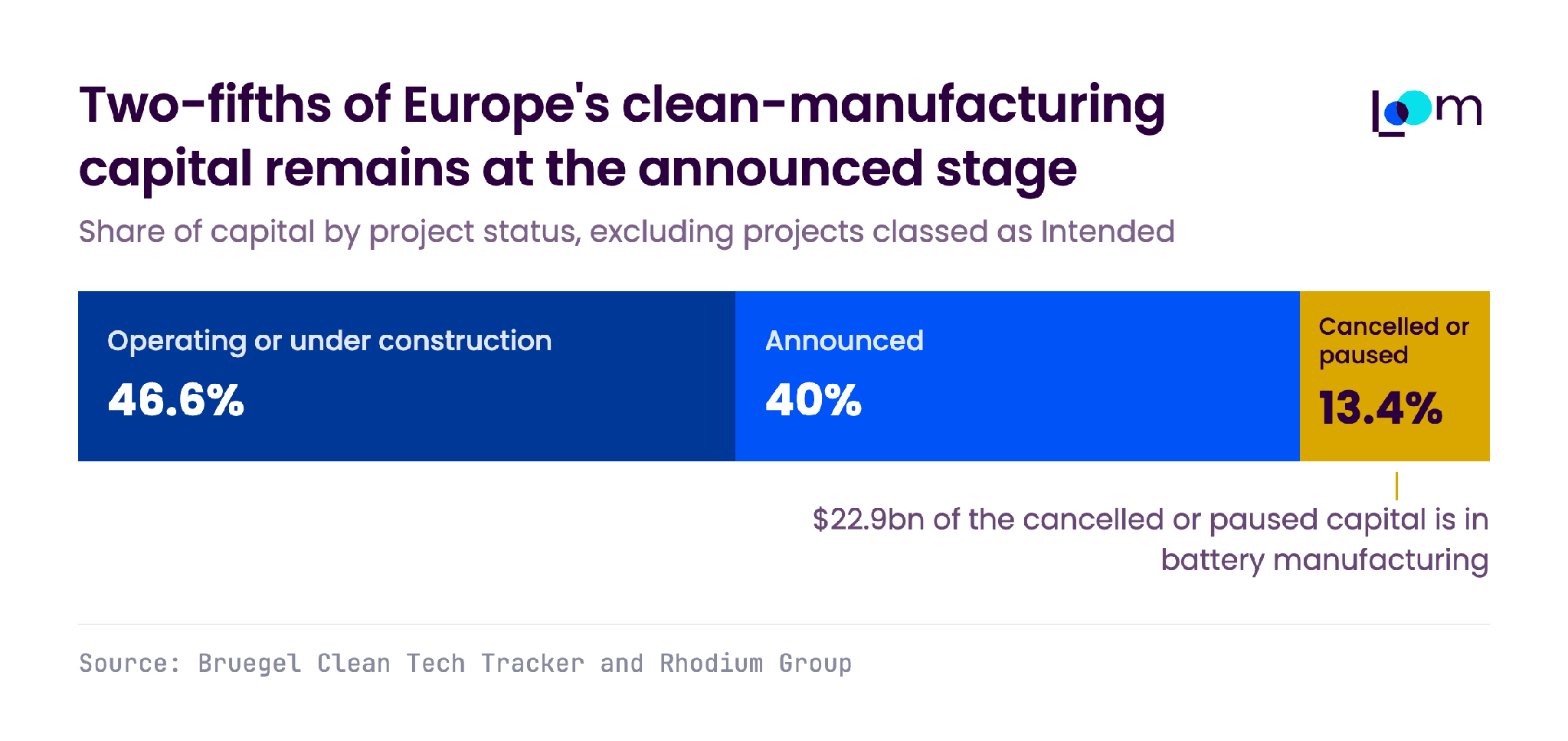
But much of Europe’s planned pipeline has not become operating capacity. Excluding projects still classed as ‘Intended’, 40 per cent remains at the ‘Announced’ stage, and 13.4 per cent has been cancelled or paused. Investment in batteries account for $22.9bn of the cancelled or paused capital.
Recent company failures show what those pipeline figures can look like in practice.
Northvolt filed for bankruptcy in Sweden in March 2025. Morrow Batteries resolved to file for bankruptcy proceedings in May. Varta applied for insolvency proceedings in July, after which a provisional insolvency administrator was appointed.
Many European politicians already signal support for domestic production in principle. Their problem is turning announced projects into factories that can scale-up and survive the global competition - and in particular, China’s dominance in these supply chains. To do this without transferring too much of the cost to households will not be straightforward.
Full reshoring is unrealistic, but the poll gives governments room to work with European and allied suppliers to get more control and avoid the most acute dependency risks. Decisions will now have to be made about which capabilities to build or reinforce nationally, which to secure with trusted partners in Europe and internationally, and where new industrial policies can help firms to operate at scale. This will require some tough calls about prioritisation.
The temptation for leaders will be to continue with something similar to the status quo, which is dominated by importing cheaper equipment from China while spreading limited public money across every clean technology here in Europe rather than focusing on technologies where there is the strongest strategic rationale. That approach is likely to secure neither the greater control the public wants, nor firms that can actually compete, but it would still consume limited fiscal capacity and this poll suggests it could also test the limits of public and political support.
Loom has been researching which innovative European companies are bringing a domestic production edge in powering, protecting and preparing nations across the multiple challenges they face. We’ll soon publish Loom100, an independent index of these firms, to offer a snapshot of where European industrial excellence in strategic technology already exists, and which could be scaled to support multiple strategic objectives at once.